
Storing yellow recycling bags: Where to keep them safely until collection

In short: In Germany, around 31 kilograms of lightweight packaging per person per year end up in Yellow Bins and Yellow Bags (Factsheet from the dual systems). Until collection, keep the bags on your own property: dry, tied shut, and preferably raised off the ground. In many municipalities, you can put them out on the street no earlier than the evening before collection.
The Yellow Bag is the most unremarkable part of waste sorting, and at the same time the one that causes the most arguments. It’s lightweight, it tears, it smells after a few warm days, and it gets in the way. If you have to store Yellow Bags, you soon realize that the real question isn’t whether they’re a nuisance, but where they’ll cause the least trouble between collections.
This guide answers that very question. You’ll learn which places are suitable for storage and which aren’t, how to secure the bag outdoors against wind and animals, when you’re allowed to put it out, and what’s different in Austria compared with Germany. One important note up front: the rules set by your municipality or waste collection provider are always binding. The examples below show how much the rules can vary.
How long do you have to store Yellow Bags?
It depends solely on your municipality’s collection schedule, which varies more than many people think. Here are a few real examples:
- Kaiserslautern District (DE): Collection every 14 days; each household receives an initial allocation of 60 bags per year (Kaiserslautern District, Yellow Bin flyer).
- Weilheim-Schongau District (DE): Yellow Bags are collected every four weeks (EVA, district-owned company).
- Kirchdorf District in Upper Austria, e.g. Nussbach (AT): Collection every six weeks (Yellow Bag information sheet, Municipality of Nussbach).
Six weeks is a long time. If you divide the 60 bags in Kaiserslautern by 26 collections a year, that works out to just over two bags per collection. If your bags are collected only every six weeks, you’ll have more full bags at home at the same time. That’s exactly why it’s worth setting up a proper storage solution once, instead of finding a new place for the full bags each time.
Where can you store yellow bags?
The short answer: on your own property or in your home, but not in the stairwell and not for days on the sidewalk. In August 2026, the Mühldorf a. Inn district reiterated this explicitly: bags should be kept on your own property until the evening before collection (Mühldorf a. Inn District Office).
Which location works for you depends on your living situation and available space:
| Location | Suitability | What you should keep in mind |
|---|---|---|
| kitchen, storage room | good for collecting | A stand or holder is useful for keeping the open bag in shape. But take full bags out promptly |
| basement | good | cool and dark, keeps odors to a minimum |
| garage, garden shed | good | store raised, not directly on the ground |
| balcony | with limitations | wind and sun, only in a closed container |
| garden, against the house wall, designated storage area | with limitations | cover against rain, protect from animals, don’t leave them open on the ground |
| stairwell, hallway | no | escape and rescue route, see below |
| sidewalk, roadside | only shortly before collection | usually permitted no earlier than the evening before |
The waste disposal company in the Weilheim-Schongau district also lists basements, garages, and garden sheds as typical places where bags can be stored (EVA).
Why the stairwell is off-limits
In apartment buildings, people often leave yellow bags outside their apartment doors. It’s convenient, but risky. The Building Regulations Office of Leinfelden-Echterdingen makes clear in its information sheet that corridors and stairwells are the first escape and rescue routes and that no items should be stored there, whether flammable or not. Anyone who leaves something there may be liable for damages in the event of an incident (Fire Safety Information Sheet, City of Leinfelden-Echterdingen). The information sheet refers to the State Building Code of Baden-Württemberg. Your building’s house rules also specify what applies in your particular case.

Storing the yellow bag outdoors: how to keep it intact
Outdoors, the yellow bag has two enemies: wind and animals. In its comparison of bags and bins, the Kaiserslautern district lists exactly these drawbacks: bags tear easily, attract wild animals, and can be blown away and split open in strong winds (Kaiserslautern district). The Mühldorf district adds why animals come in the first place: food residue on the packaging.
Follow these seven simple steps to keep both at bay:
- Collect only empty packaging. You don’t need to rinse packaging, but it must be completely empty. Food scraps must be disposed of separately, not in the yellow bag (Waste sorting works). The fewer leftovers, the less odor and the less interest from animals.
- Don’t overfill it. A bulging bag can tear when lifted, and a bag that can no longer be tied shut is exposed to wind and pecking beaks.
- Tie it tightly. In the Kaiserslautern district, this is even part of the collection rules: bags should be tied shut and placed at the roadside.
- Store it above ground. The Bavarian Association for Bird and Nature Conservation (LBV) recommends hanging bags on a fence, for example, with some clearance from the ground. The reason: hedgehogs tear the plastic while searching for food or crawl into open bags and can get trapped between cans (Ökotest with LBV).
- Use a closed container. A sturdy box with a lid outdoors or a disused rain barrel keeps out wind, rain, and animals. Make sure it has a solid base; otherwise, the bag is still vulnerable from below.
- Place it in a wind-protected spot. Choose a house wall, carport, or alcove rather than an open lawn. Even a light bag can blow across the driveway in a moderate wind.
- Keep it out of the sun. Heat intensifies odors. A shady spot keeps the contents more tolerable for longer, especially in summer.
If maggots appear despite all this, it’s almost always because of food scraps. Find out what helps in the article about maggots in the trash can. And if rats or mice are your main concern, you’ll find more information in the article about rats and trash.
When can you put the Yellow Bag out?
There is no uniform rule here, either in Germany or Austria. Your municipality or waste collector determines when you may put the bag out. These examples show the range:
| Municipality / waste collector | Country | At the earliest | At the latest |
|---|---|---|---|
| Mühldorf a. Inn District | DE | the evening before collection day | not specified |
| Kaiserslautern District | DE | the evening before | 6:00 a.m. on collection day |
| Weilheim-Schongau District (EVA) | DE | not several days in advance | 6:00 a.m. on collection day |
| Kirchdorf District (Upper Austria), e.g. Nussbach | AT | the evening before | 6 a.m. on collection day |
Sources: Mühldorf District Office, Kaiserslautern District, EVA Weilheim-Schongau, Information sheet for Kirchdorf District, e.g. Nussbach.
The pattern is still clear: In many municipalities, the evening before is the earliest you can put bags out, and collection is already underway early in the morning. Mühldorf explains the reason for the rule very clearly: Bags left on the sidewalk for days attract more bags from the neighborhood, get blown away by the wind, torn open by animals, and block sidewalks.
One detail that hardly any guide mentions: From an animal welfare perspective, the evening before is not ideal either. The LBV recommends putting the bags out early in the morning, when hedgehogs are no longer out and about. If your municipality allows it as late as 6 a.m. and you’re heading out early anyway, that’s the gentler option.
You can find your collection dates in your municipality’s waste calendar or waste app. For example, the information sheet for the Kirchdorf district refers to the Abfall OÖ app.
How is it different in Austria than in Germany?
The name is the same, but the systems behind it are not quite.
In Austria, since 2025, plastics, other lightweight packaging, and metals have been collected together in the yellow bin or yellow bag (oesterreich.gv.at). So cans and other metal packaging go in the bag too. Exceptions are paint, aerosol, varnish, and oil cans that still contain product: These must be taken to a hazardous waste collection point. In the Kirchdorf district (e.g. Nussbach), a bag containing incorrectly sorted items gets a red sticker and is left behind until you sort it again. You can’t take the Yellow Bag itself to the recycling center there, but you can take loose lightweight and metal packaging. This can help if too much builds up before the next collection.
In Germany, the Yellow Bag is funded by the dual systems, not through municipal waste collection fees. The Kaiserslautern district says it has no influence over the tender or contract award. Only packaging materials can go in the bag: plastic toys and household items belong in general waste or bulky waste, and serious violations can be punished with a fine. Relevant to storage: the district explicitly cites using the bags for other purposes, such as storing household items, as one reason why the initial distribution is not enough.
Both countries have one thing in common: Your region decides whether you get bags or bins and when they’re collected. At the start of 2026, for example, the Kaiserslautern district asked its households whether they wanted yellow bins from 2028, noting that the whole district would use either bags or bins, with no mixed system.
Yellow bag, stand or yellow bin: Which one is right for you?
There are basically three ways to store them. The stand solves the collection problem, the box provides temporary storage, and the bin does both but takes up space.
| Solution | Strengths | Weaknesses |
|---|---|---|
| Yellow Bag stand or holder (indoors) | keeps the bag open while you fill it, takes up little space | only solves collection; full bags still have to go somewhere |
| Box or crate with a lid (outdoors) | protects from wind, rain, and prying eyes | needs a solid bottom to keep out rodents; space in front of the house |
| Yellow bin instead of bag | According to Kaiserslautern District: clean storage, no problems with animals, no waiting for a refill | takes up more space; at home, you collect waste loose or in your own garbage bags |
The pros and cons of bags and bins come from a comparison by the Kaiserslautern District. There, the yellow bin is also 240 liters, the same size as the blue paper bin. Whether you can get a yellow bin depends not on the space you have, but on your region.

And what does the garbage bin box have to do with it?
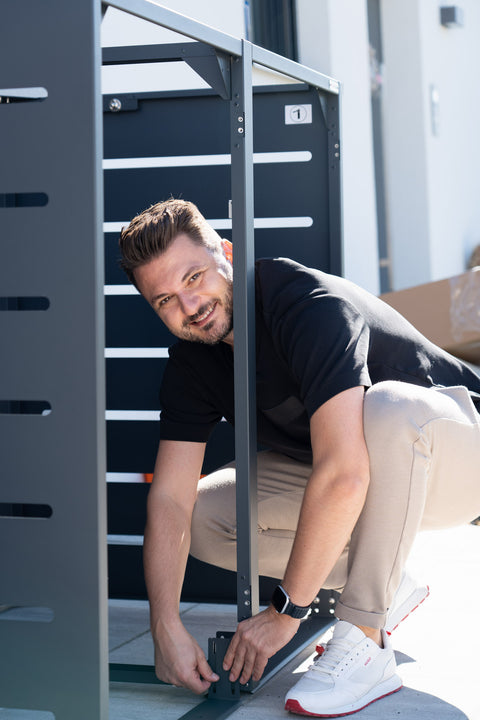
A garbage bin box is designed for 120- or 240-liter bins and can also include a compartment for the yellow bag. The page for the 4 boxes garbage bin box describes exactly this arrangement: general waste, organic waste, paper, and the yellow bag behind a single, understated front. For labeling, there are magnetic signs, including a yellow version, designed for garbage bin boxes with steel doors. And if a yellow bin becomes available in your area later, it’s simply another bin at the collection point. For a 240-liter bin, you’ll need a compartment that’s large enough.
One point to know when the bag goes in the compartment: According to the product page, Dagobert has a slatted housing with an open bottom. The FAQ says it has slats all around and no closed sides or back panels (Dagobert product FAQ), and the open bottom ensures good ventilation. That makes sense for bins. For the bag, it means it can be stored neatly in the compartment, but the compartment is not rodent-proof because of the open bottom. If mice or rats are an issue for you, also put the bag in a box with a solid bottom inside the compartment.

How many compartments you actually need for your bins depends on your municipality and household size. The guide Which garbage bin box is right for you? works it out step by step. And the comparison 120- or 240-liter garbage bin can help you decide which size to choose.

How to keep your yellow bag from smelling
A yellow bag shouldn’t smell at all, since it’s only for empty packaging. If it does, it’s almost always because of leftovers. Three rules help more than any air freshener:
- Empty, not clean: Rinsing isn’t necessary, but containers should be emptied. A yogurt cup scraped clean will barely smell after a few days, while a half-full one can smell after just a few hours.
- Remove lids, don’t stack: Separate lids and cup seals and put them loose in the bag. Don’t nest packaging inside one another, as this makes the sorting plants’ work harder and hinders recycling (Waste sorting works).
- Store in a cool, airy place: A bag in the basement lasts much longer than one left in the sun on the balcony.
If it still smells, the guide Garbage bin smells: What can you do to get rid of the odor right away? can help. For the collection container in your kitchen, you’ll also find specific tips in the article about Maggots in the garbage bin.
Frequently asked questions about storing yellow bags
Where’s the best place to store yellow bags?
It’s best to keep them on your own property in a cool, dry place: a basement, garage, or garden shed. Outdoors, the bag should be tied shut, sheltered from the wind, and raised off the ground, ideally in a container with a lid and solid base.
Can I leave yellow bags in the stairwell?
It’s better not to. Stairwells and corridors are escape and rescue routes. Fire safety guidance, such as that issued by the City of Leinfelden-Echterdingen, advises against storing any items there and points out that you may be liable in the event of damage. Check your building’s house rules for what applies.
When can I put out the yellow bag?
Your municipality decides. In many municipalities, such as Mühldorf a. Inn district or Kirchdorf district in Upper Austria, you can put it out no earlier than the evening before collection day. It often has to be out by 6 a.m. on collection day at the latest. Your waste collection calendar shows the exact date.
Will the yellow bag be phased out in 2026?
Whether the bag is phased out depends on your region, not on a set date. Kaiserslautern district, for example, surveyed households in early 2026 on whether yellow bins should be introduced from 2028. In Austria, waste is collected in yellow bins or yellow bags depending on the municipality, but since 2025, plastic and metal packaging have been collected together.
Do food cans go in the yellow bag in Austria?
Yes. Since 2025, plastics, other lightweight packaging, and metals have been collected together in yellow bins or yellow bags throughout Austria. Paint, spray, and oil cans that still contain product are excluded and belong at a hazardous waste collection point.
What should you do if your yellow bag wasn’t collected?
First, check whether there’s a sticker on the bag. In the Kirchdorf district of Upper Austria, for example, the waste collector marks bags containing incorrectly sorted waste with a red sticker. They’re then collected only at the next pickup after the waste has been sorted out. If there’s no notice, it’s worth calling your waste collector’s hotline.
Conclusion
Storing yellow bags is mainly a matter of location and timing:
- Location: On your own property, in a cool, dry place, raised off the ground. Not in the stairwell and not on the sidewalk for days.
- Protection: Collect bags only when empty, don’t overfill them, tie them securely, and store them where they’re protected from wind and animals.
- Timing: Put it out no earlier than your municipality allows; for animal welfare, morning is better than evening.
And if your area switches from bags to yellow bins one day, the only question is where to put one more bin. The guide How to Hide Bins shows you how to plan the spot so it looks tidy while still allowing waste collection access.





