
Which garbage bin box suits you? Choose the right size & quantity
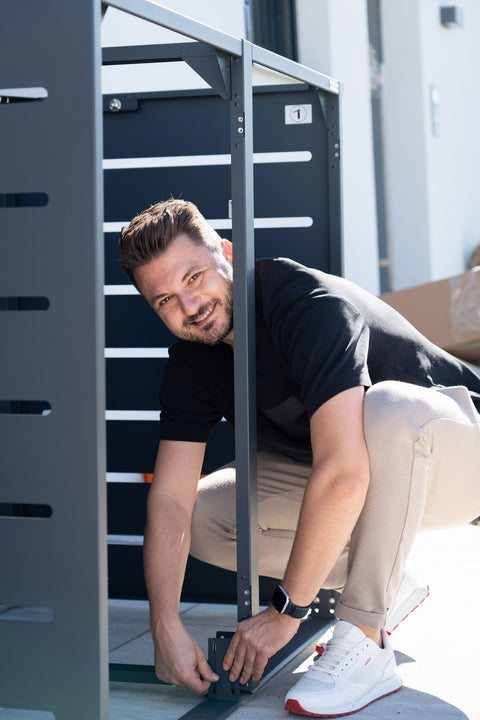

In short: The right garbage bin box results from three decisions: how many bins you need to store (number: 1 box to 6 boxes), whether they are 120-liter or 240-liter bins, and how much outdoor space is available. A 2-person household usually does well with a 2-box or 3-box, a family with four waste separation fractions usually needs a 4-box. If unsure, measure the space first and then decide on the number.

Quick decision: The right box in 30 seconds
In almost all customer conversations in our showroom in Leonding, the decision follows the same pattern, and you can use it as a guide:
- Count your garbage bins. In Austria, these are usually residual waste, organic waste, waste paper, and yellow bag or yellow bin. In Germany, depending on the federal state, there is also the recyclable bin.
- Look at the volume printed on your bin. The standard sizes are 120 liters (small, mostly single households) and 240 liters (standard for families and multi-person households).
- Measure the space in width and depth. Only when the width is fixed can you decide whether a 3-box, 4-box, or 5-box fits.
Everything else is fine-tuning: material, roof (folding or plant roof), color, lockability. The size question comes first.
Step 1: How many garbage bins do you have?
The number of bins depends on two things: the regional waste separation regulations and the actual amount of waste generated in the household. According to Statistik Austria, around 4.76 million tons of municipal waste were generated in Austria in 2023, which corresponds to about 525 kg per capita per year (Statistik Austria). In Germany, the per capita amount of household waste in 2022 was about 438 kg (Destatis). This means roughly 25 to 30 kg of waste per week in a 3-person household, divided into four fractions.
Typical number of bins by type of residence
| Living situation | Typical number of bins | Recommended box |
|---|---|---|
| Single / small apartment | 1 to 2 (residual waste + organic waste) | 1 box or 2 boxes |
| Couple / small family | 2 to 3 | 2 boxes or 3 boxes |
| Family with children | 3 to 4 | 3 boxes or 4 boxes |
| Multi-family house (2 households) | 4 to 5 | 4 boxes or 5 boxes |
| Multi-family house (3 households) | 5 to 6 | 5 boxes or 6 boxes |
If you’re unsure, choose one box size larger. Extra space is practically used for garden waste, cartons, or the yellow bag; no compartment stays empty long.
Special case: 4 separate waste fractions
In Austria, the 4-fraction separation (residual, organic, paper, yellow bag/plastic) is standard. Many municipalities also collect glass and metal at local collection points, so you don’t have to store those at home. But if your municipality provides a separate recycling or yellow bin (common in German cities), you quickly end up with 4 bins. The 4 boxes garbage bin box is exactly why this is our best-selling size.
Step 2: 120 or 240 liters?
The second dimension is the bin volume. Both sizes are standardized across Europe (EN 840) but differ noticeably in external height:
| Bin volume | Typical dimensions (W × D × H) | For what |
|---|---|---|
| 120 liters | approx. 48 × 55 × 93 cm | Small households, short emptying intervals, organic waste |
| 240 liters | approx. 58 × 73 × 107 cm | Standard residual waste, paper, yellow bag |
Rule of thumb: If you have residual waste collection every 14 days, a 120-liter bin is often not enough; 240 liters is the norm here. For weekly collection, 120 liters may suffice. For paper with monthly collection, 240 liters is almost always necessary.
In the showroom, we regularly see combinations: residual waste 240 L, organic waste 120 L, paper 240 L, yellow bag 240 L. This fits exactly into our 120L/240L combo garbage bin box. Details on the combination logic are thoroughly described in the guide “Combining 120L and 240L".
Space requirements: External dimensions of 1 box to 6 boxes garbage bin boxes
The most common rework in customer projects happens because someone planned the box mentally but didn’t measure the actual width. For a BIO Stefan box, use these guideline values for 240-liter bins (without roof overhang):
| Model | Width (approx.) | Depth (approx.) | Height (approx.) |
|---|---|---|---|
| 1 box 240L | 80 cm | 90 cm | 130 cm |
| 2 boxes 240L | 150 cm | 90 cm | 130 cm |
| 3 boxes 240L | 220 cm | 90 cm | 130 cm |
| 4 boxes 240L | 290 cm | 90 cm | 130 cm |
| 5 boxes 240L | 360 cm | 90 cm | 130 cm |
| 6 boxes 240L | 430 cm | 90 cm | 130 cm |
120-liter versions are about 15 cm narrower and 15 cm lower per bin. Add values for doors (opening radius approx. 50 to 60 cm to the front), otherwise the open door blocks the sidewalk.
Why the ground surface matters
Width alone is not enough: A 5 boxes box on grass or gravel can sink. We generally recommend our customers a solid, level base. More on this in the Garbage Bin Box Foundation Guide and in the article Choosing the base.
Which garbage bin box for which house?
Terraced house / narrow front garden
Typical: Front garden width 4 to 5 m, space for the box beside the entrance. Here almost always a 3 boxes or 4 boxes box with flip lid fits; the lid must not protrude over the sidewalk. Alternative: a 2 boxes box next to the driveway and a separate 2 boxes box in the back garden.
Single-family house with driveway
The driveway is usually 3 m wide; here a 4 boxes box fits lengthwise or two 2 boxes boxes at a corner. For long driveways, a 5 boxes box is also no problem as long as the car is not scratched. For the typical single-family house, our Dagobert 4 boxes with plant roof is the most popular option because it does not look like a garbage storage.
Multi-family house / commercial
From 5 bins, most planners think of a single 5 boxes or 6 boxes box. This is neat but often saves work because a single unit is easier to clean and lock than two separate boxes. Important: Plan access for the garbage truck; the radius for pulling bins must remain clear.
Rental apartment / shared area
Rarely the resident but the property manager is the decision-maker here. Recommendation: A lockable 5 boxes or 6 boxes box (details on locking systems in the article Lockable Lid Garbage Bin Box), so neighbors or passersby cannot throw in foreign waste. This is the most common cause of trouble in housing communities.
The four typical mistakes when choosing size
- Measured too tight. Those who plan only the bin size plus 1 cm get annoyed because the bin gets stuck when rolling out. Add 3 to 5 cm per bin.
- Forget the future. Those who have 3 bins today often face 4 in five years (new organic waste collection, new recycling bin). Better to choose a size bigger right away.
- Flip lid without ceiling clearance. The lid swings upward. Under roof overhangs or carports, the necessary height is often missing (at least 180 cm from the top edge of the box).
- Forgot the yellow bag. The yellow bag is not a bin, but it is often stored in the bin compartment. Those who regularly accumulate yogurt cups and plastic bottles still need a fourth compartment or an extra shelf.

Conclusion: Think bigger, measure precisely
The most common feedback from BIO Stefan customers is: "I should have chosen one size larger right away." Our advice to you: choose the number just enough, but not too tight; measure dimensions twice, then decide. If you are looking for a box that comes in any RAL color at the same price, is produced in the EU, and hot-dip galvanized (15+ years warranty), you will find the right size in the BIO Stefan garbage bin box range, from 1 box to 6 boxes. The models are set up in our showroom in Leonding near Linz. You don’t need an appointment, just a quick call is recommended.
Frequently Asked Questions
What garbage bin box size do I need for 4 people?
For a 4-person household with 4 separated waste fractions (residual waste, bio waste, paper, yellow bag), a 4 boxes garbage bin box is common. For three fractions, a 3 boxes box with 240-liter bins is sufficient. The decisive factor is not just the number of people but the number of bins and their collection intervals.
120 liters or 240 liters, which bin for which fraction?
For residual waste and paper, we recommend 240 liters for families; 120 liters is enough for bio waste because bio bins are usually collected weekly. Yellow bins in Germany are often 240 liters. In Austria, the yellow bag is usually used instead of a yellow bin; for this, a compartment with a narrower 120-liter bin or an open bag holder is sufficient.
How much does one more compartment in the box cost me?
For each additional compartment, the price at BIO Stefan increases by about 200 to 350 euros depending on the model series. Measured over a usage period of 15+ years, that is just a few euros per month, significantly cheaper than buying a second box later and placing it next door.
How wide is a 3 boxes garbage bin box for 240 liters?
A BIO Stefan 3 boxes garbage bin box for 3 × 240 liters is about 220 cm wide, 90 cm deep, and 130 cm high on the outside (without roof overhang). The 120-liter version is correspondingly narrower; expect about 180 cm width.
Can I combine two small boxes instead of one large one?
Yes. If you have two separate locations (e.g., a 2 boxes in front for residual and bio waste, and a 2 boxes in the back for paper and yellow bag), you get more flexibility and shorter distances. Disadvantage: two boxes require two foundations and two purchases. For one overall parking space, a single larger box is usually more economical.
What size should I choose if my waste separation changes in the coming years?
Plan one size larger. In Austria and Germany, the number of separated waste fractions has been increasing for years; new bio-bin requirements and municipal recycling bins are common. An empty compartment will be filled later; a box that is too small must be replaced.
About the Author: Erwin Sabic is the founder and driving force behind BIO Stefan. Since 2018, he has been advising customers in Austria, Germany, and the EU area on the topic of garbage bin boxes, by phone, in the Leonding showroom, and on construction sites of architects and developers.





