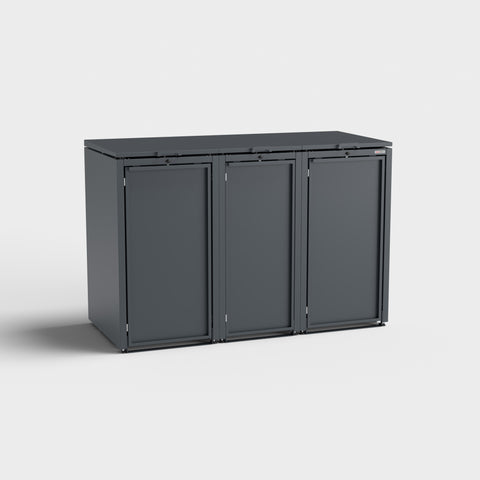
Wood garbage bin box Holzmichl 2 boxes for 120 & 240 liters in anthracite with plant roof
Wood look that disappears into the garden: the Holzmichl 2 boxes with plant roof
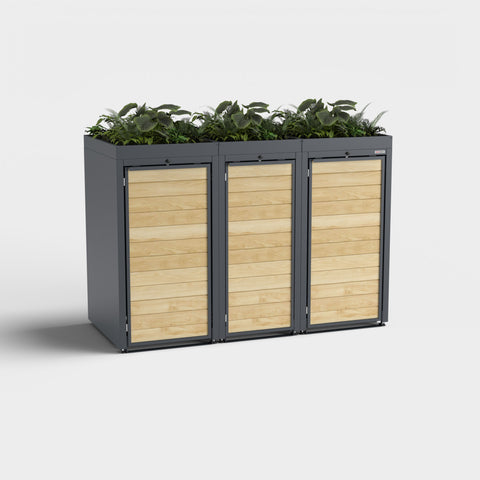
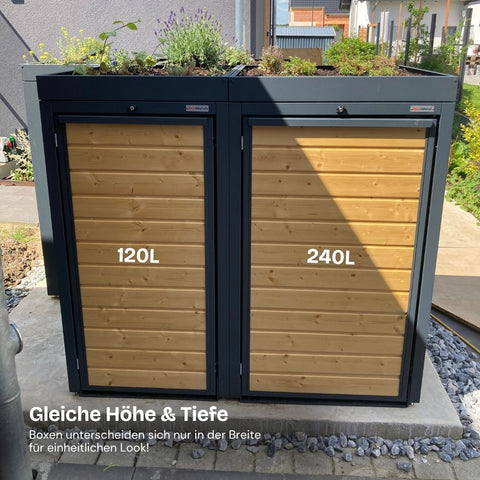
Two bins, a calm front, and a roof that blooms along: This Holzmichl 2 boxes garbage bin box in anthracite (RAL 7016) stands right next to the carport, housing a 120-liter and a 240-liter bin. The spruce wood inlay removes the technical feel from the footprint, while the plant roof with lavender, herbs, and sedum turns the garbage bin enclosure into a piece of the garden.
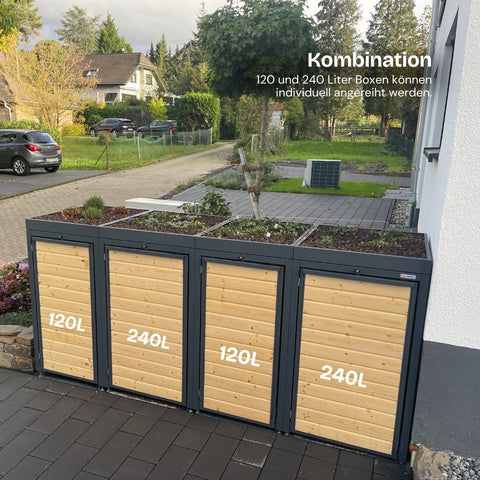
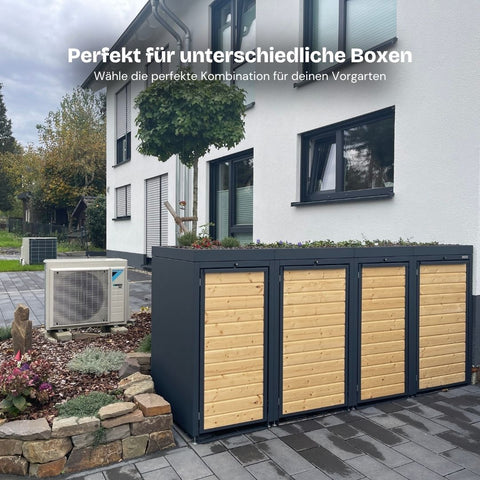
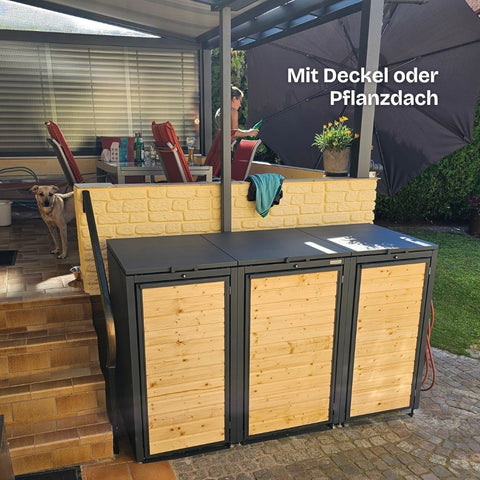
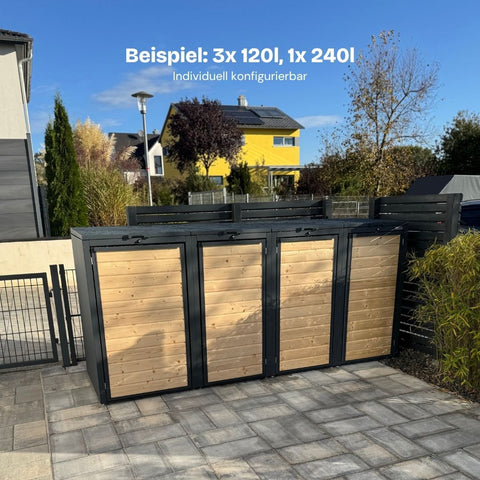
In the customer photos, you see the box in two setups: once around the corner at the house entrance on the wooden facade, and once frontally on the plastered house wall. The Holzmichl 2 boxes combination is made exactly for this mix of visibility and everyday practicality. Holzmichl 2 boxes combination made for.
Who is the Holzmichl 2 boxes combination worth it for?
The 2 boxes version with a 120-liter and a 240-liter bin is the classic for households that want to keep two bins neatly together without building an entire wall.
Typical use cases
Terraced house or single-family home with residual waste and a second fraction
Parking space next to carport, house entrance, or at the property boundary
Front gardens where the box remains visible from the street
Households that prefer a wood look but want a weatherproof steel body
Typical allocation of the two boxes
1 x 240 liters for residual waste
1 x 120 liters for organic waste or paper
Alternatively, two identical fractions if the waste volume is higher
Those who need to accommodate more bins will find the same wood front also as Holzmichl 2 boxes in pure 120- or 240-liter configuration or as larger sets in the category 2 boxes garbage bin boxes.
Wood front meets anthracite: material and color
The body consists of weatherproof steel in robust sheet thickness, hot-dip galvanized and then powder-coated. This construction provides weather and corrosion protection that keeps a box looking good outdoors for years.
A spruce wood inlay is set into the anthracite-colored frames, framed by a surrounding frame. This creates the warm wood look of the front, while the roof, edges, and sides maintain the clear anthracite line. The photos clearly show how calm this combination looks next to a wooden facade and how it stands out against a light plaster wall.
In addition to anthracite (RAL 7016), the Holzmichl is also available in pure white, white gray, tele gray, black, gray aluminum, and cream white. You can see which color tones are currently available directly on the product. The entire wood line can be found in the category garbage bin boxes made of wood.
Plant roof, lid, and everyday access
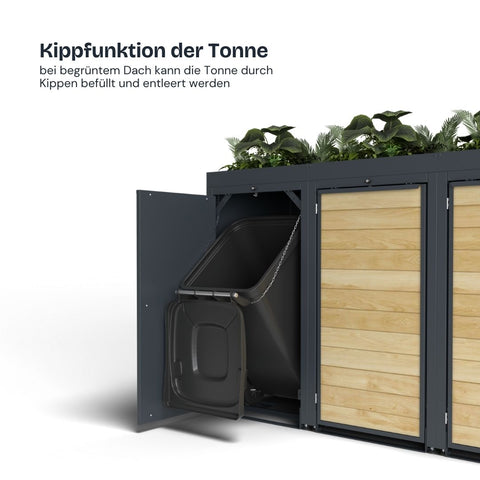
The plant roof plays the main role here: the upper tray can be planted, with lavender, low herbs, and cushion perennials growing on it in the pictures. This gives the box a green top instead of showing a bare lid. For those who prefer a simpler look, the same box can also be chosen with a flip lid, visible in the category garbage bin box with plant roof.
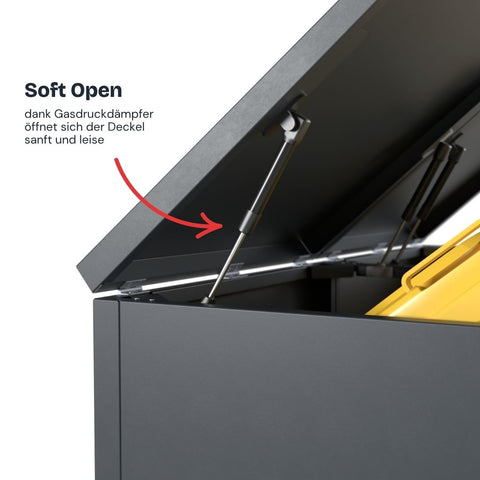
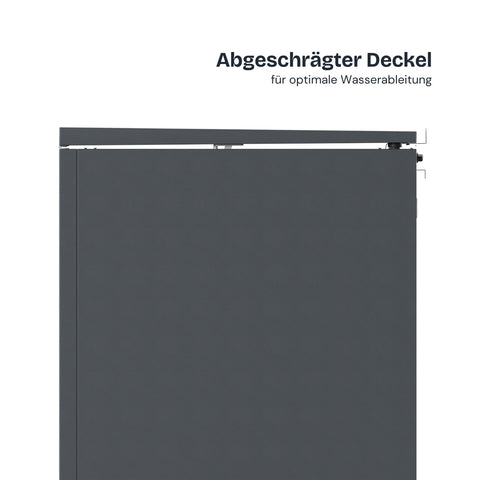
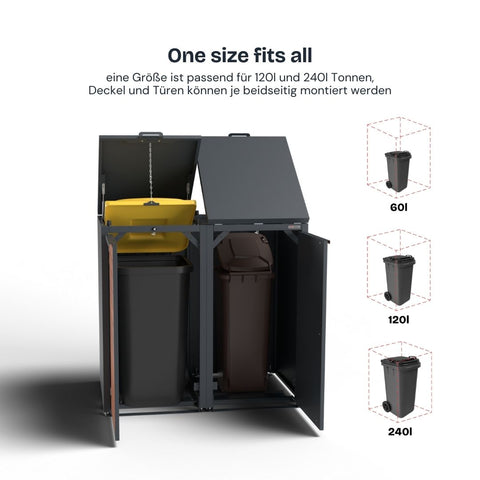
The convenience remains the same when throwing in waste: the lid opens gently via gas pressure dampers and closes softly via impact dampers. The bin lid inside opens synchronously as soon as you hook in the supplied chain, so you don’t have to touch the bin separately. Lid and door can be locked together with a central lock, protecting the bins from curious hands and wind.
Space requirements and ground: how to place the box securely
To ensure the Holzmichl stands as neatly as in the photos, it’s worth taking a quick look at the dimensions and ground.
The clear width per bin space is:
120-liter space: about 51.5 cm wide, 70 cm deep, 99 cm high
240-liter space: about 61.5 cm wide, 80 cm deep, 109 cm high
With the plant roof, the 240-liter box reaches a height of about 123.5 cm, without the plant roof about 118 cm. Allow enough swing space in front for lids and doors.
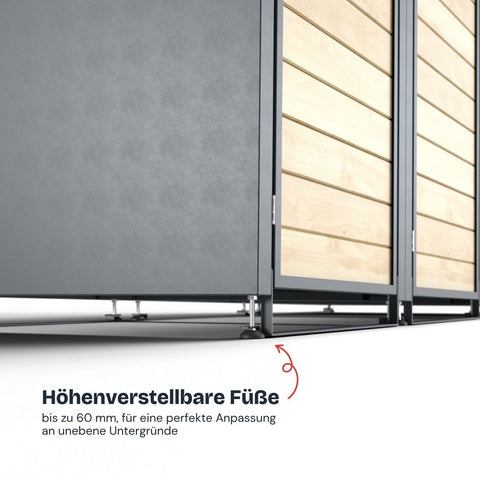
Suitable ground surfaces include paving, concrete, or a compacted area, like the gravel and chippings strips shown in the pictures all around. The adjustable feet compensate for ground unevenness of about 15 to 60 mm, so the box stands straight even on a slight slope. Screwing it down is not absolutely necessary, but the box can be additionally anchored if needed via pre-drilled holes in the base rails.
Conclusion: wood look with a green roof for two bins
The Holzmichl 2 boxes in anthracite combines a warm spruce wood front with a weatherproof steel body and a planted roof that blends into the garden. For households with a 120- and a 240-liter bin who value aesthetics, it is one of the most discreet solutions—a box that looks more like a flower bed than a garbage bin storage.
Frequently asked questions about the Holzmichl 2 boxes with planted roof
What wood is the front of the Holzmichl garbage bin box made of?
The front consists of a spruce wood insert framed by a surrounding frame. The rest of the body is made of weatherproof, powder-coated steel.
Does the 2 boxes combination really fit a 120- and a 240-liter bin?
Yes. The version shown is designed exactly for that: one space for a 120-liter bin and one for a 240-liter bin. The configuration can be freely chosen on the product.
Can I plant the planted roof myself?
Yes, the upper tray is intended for planting. Customer photos show lavender, herbs, and low cushion plants growing on it. Low-maintenance, drought-tolerant plants are best suited.
Does the garbage bin box need to be screwed to the ground?
No, screwing is not strictly necessary. You can additionally anchor the box to the ground if needed through pre-drilled holes in the base rails.
Does the box stand straight even on a slight slope?
Yes. The feet have adjustment screws that compensate for ground unevenness of about 15 to 60 mm. This allows the box to be leveled even on slightly sloping ground.
How much space do I need for the 2 boxes Holzmichl?
Depending on the configuration, plan for a clear width of about 51.5 cm (120 liters) and 61.5 cm (240 liters) plus the frame. With the planted roof, the height of the 240-liter box is about 123.5 cm. Make sure to leave enough room in front of the front to open the lid and doors.